



Choice Drivers and Switching
For most travelers, airline choice comes down to value. Price is almost universal (96.7%). After price, practicality takes over. Schedule/timing (60.0%) and nonstop availability (45.6%) are what make a trip workable. They’re the difference between a cheap fare you can take and a cheap fare you can’t.
Then it drops off to baggage policy (32.2%) and seat comfort (30.0%). Brand trust (26.7%) trails the itinerary basics. Loyalty/status show up (14.4%), but they aren’t the main driver for most shoppers, which matches the qualitative theme of “cheapest deal.”
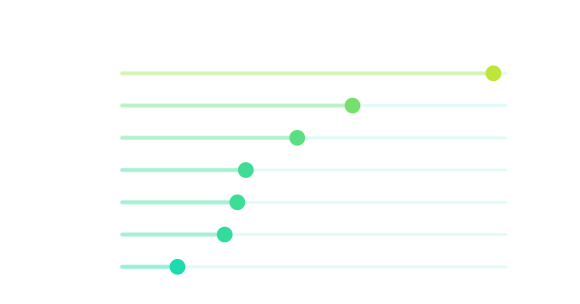
Switching is driven by clarity. The most compelling offer is bundling fees into a single price (43.3%). People want fewer surprises and an easier way to compare options across carriers.
A free upgrade chance (31.1%) matters, but it comes after transparency. Flexible change policy (12.2%) and guaranteed seat selection (8.9%) are smaller levers, and lounge access (4.4%) is niche. Overall, switching is driven more by reduced uncertainty than by premium signaling.

Most Frustrating Parts of Flying
The biggest frustration is operational reliability. Delays and cancellations lead decisively (41.1%). They’re far ahead of every other pain point. For a lot of travelers, the most important part of the experience is simply arriving on time.
After that, frustrations cluster around uncertainty and discomfort: hidden fees (16.7%), seating/legroom (16.7%), and boarding process (15.6%). The common theme is unpredictability, whether it’s time lost, money added, or a physically uncomfortable experience.

Most travelers don’t behave like loyalty-maximizers. The largest share says loyalty is a minor consideration (38.9%), and nearly a third say it doesn’t matter at all (32.2%). For acquisition, that’s the takeaway: for many people, points won’t override price and itinerary.
At the same time, a meaningful minority treats loyalty as major (26.7%). This points to two tracks. Loyalty is powerful as a retention tool for a subset, and it isn’t the universal driver of choice, especially when schedules, nonstops, and all-in pricing are on the table.

How Travelers Book
A plurality book directly with airlines (43.3%), but nearly as many book through travel sites (36.7%). This means a large share of decisions are happening in comparison environments where price, schedule, and “true total cost” are easiest to evaluate.
Smaller channels still matter for specific segments. Travel agents (8.9%) and Google Flights (7.8%) reflect different planning behaviors. Credit card portals (2.2%) and corporate tools (1.1%) are niche in this sample. The implication is simple: you need strong offers and clarity on your own site and in third-party comparison contexts.

The free-text answers match the quantitative story. Price is the dominant reason, often stated plainly as “cheapest.” Schedule/timing comes next, followed by nonstop and layovers. There’s also a smaller trust and habit cluster, plus some external influence like family or an agent choice.
Points and status appear, but they are not the main story in the open text. That mirrors the loyalty question, where most travelers describe loyalty as minor or irrelevant. In plain terms, people optimize for an itinerary that is cheap enough, convenient enough, and reliable enough. They switch when uncertainty, like fees or delays, becomes too costly.

Choice Is Value, Switching Is Clarity
Across the study, the same decision logic keeps showing up. Travelers pick the cheapest itinerary that still feels workable. They switch when costs or reliability feel uncertain.
- Price is the universal filter (96.7%) and the dominant free-text “why.”
- Convenience closes the sale: schedule (60.0%) and nonstop (45.6%) are the next tier.
- Reliability is the #1 pain: delays/cancellations lead frustrations (41.1%).
- Clarity drives switching: bundling fees is the top switching offer (43.3%).
- Loyalty is secondary for most: minor/not at all outweighs major/only (71.1% vs 28.9%).
- Decisions happen in both direct and comparison channels: airline site/app (43.3%) and OTAs (36.7%) are both critical.
The implication is straightforward. Win share by making the true total price easy to understand, pairing competitive fares with workable schedules and nonstop options where possible, and reducing the perceived risk of disruption through reliability signals and straightforward policies. Loyalty programs matter mostly as a retention layer for a smaller segment.
The Market Chooses “Cheapest Acceptable”
Travelers aren’t primarily choosing airlines as brands. They’re choosing itineraries that minimize cost and friction. The carriers that win make value feel obvious and reliability feel dependable.
This study shows a consistent hierarchy. Price dominates. Schedule and nonstop availability determine practicality. Delays and cancellations define the emotional pain of flying. Switching behavior is especially telling: bundling fees is the most persuasive lever because it converts uncertainty into a comparable number.
The path forward is clear. Compete on total price with fewer surprises. Strengthen the itinerary proposition where it matters, timing and nonstop. Communicate reliability in concrete terms that address disruption risk. Then tailor loyalty and perks to the segments that actually value them, and don’t treat that group as the whole market.